
When listening to a podcast, have you ever wondered how the host can talk so knowledgeably yet effortlessly? Chances are that the podcast host put in a lot of time and effort to come across so casually. Before the host can sit down in front of that microphone and record, planning must take place.
Beyond a script, multiple elements go into making a successful podcast, including hooks, taglines, and even the sound itself.
READING & WRITING
Chapter 8-Sound
Sound itself is caused by something vibrating; in our case, our voices are produced when air from our lungs passes over and vibrates the vocal cords. The human eardrum itself is a thin membrane that vibrates when sound waves reach it. These vibrations are converted into nerve impulses, which are sent to the brain for translation into the sound we hear.
In connection with this, a microphone mimics the ear. Like the thin membrane of the eardrum, each microphone has a diaphragm that vibrates when hit by sound waves. These vibrations are then converted to an electrical signal that can be broadcast or recorded.
There are two basic types of microphones: dynamic and electret condenser.
Sync sound is recorded in sync with the camera. Voice-over is a narrative voice that plays over a picture, with the person not seen. Present or ambient sound is the noise you hear in the background of a location.
How to Write an Invisible Script
An invisible script comes across so naturally from the speaker that it sounds unrehearsed or unplanned, when it is partially planned. This is so the speaker has a set track for the podcast discussion, allowing them to stay on topic while still allowing ad-libbing.
An important thing to keep in mind while writing any script, especially an invisible script, is narrative flow. Narrative flow is how you not only capture the audience’s attention but also convince them that they will benefit from listening to your podcast.
Hooks, Taglines, and the Power of Words
A tagline is a short, simple phrase that advertises your podcast. There are two methods for creating a tagline. The first method is the two-step method, which is the most common method. First, you tell the audience who you are or what the podcast is called. After that, you tell them what the podcast is about, what it will do for the listener.
Tools for Podcast Planning Perfection
This article lists suggested tools to help someone create their own podcast. The tools listed range from physical items to buy, such as a microphone, to digital tools, such as an all-in-one podcast editing software. It is not necessary to purchase all or any of the tools in this article; it is just a collection of tools to make podcasting easier.
How to Present a Perfectly Scripted Podcast
This article comprises three chapters; the first chapter discusses how to use a shorter, more concise script. This is so you do not have to remember too much, but you also want to be familiar with your notes so you can still talk about the topic at length. This chapter also discusses how, as a presenter, you should be assertive but not aggressive, and mindful of pitch and pacing.
Chapter two discusses overcoming your fear of public speaking. Are you afraid of sounding stupid? It will go away with time. Are you scared of messing up, losing your place, or forgetting something? No worries, it’s a recording! You can redo whatever parts you need to. If you’re concerned about people not thinking it’s any good? Rest assured that if you get your point across clearly and coherently, your audience will be happy. Also, there is no need to rush for a finished product either; practice makes perfect.
Chapter three discusses the importance of warming up, as it is vital for any professional vocalist. This chapter continues with several methods to help warm up a voice before recording a podcast, such as humming or singing. Relaxing your jaw, breathing deeply, and maintaining good posture, to name a few.
Creating a Great Podcast Script: 3 Methods Top Podcasters Use
There are three primary methods that podcast hosts use to create their script. The first method is a Word-for-Word script, which, as its name suggests, is written word-for-word from what the host will say. This method helps ensure no topic is left out by accident. Though with this method, scripts can sound monotone and too scripted.
The second scripting method is a detailed outline for a podcast episode. This method is a good middle ground between detail and flexibility, allowing you to stay on track while still sounding conversational. Though this method can lead to distraction as you try to read and improvise at the same time.
The last scripting method is a bullet point list plan. This method is quick to plan and is the most flexible. A caveat with this method is that it can lead to tangents or fluffy content; it is easy to miss valuable points, and it also takes both confidence and skill to do well.
Anderson, K. (2021, January 13). The art of creating an invisible podcast episode script. The Podcast Host. https://www.thepodcasthost.com/planning/the-invisible-podcast-script/
Anderson, K. (2024, June 14). Podcast taglines, hooks, & the power of words. The Podcast Host. https://www.thepodcasthost.com/planning/hooks-taglines-power-of-words/
Cudmore, R. (2023, October 13). Podcast presentation skills: Honing your speechcraft. The Podcast Host. https://www.thepodcasthost.com/presenting-your-podcast/podcast-presentation-skills/
Gray, C. (2024, January 10). Creating a great podcast script: 3 methods top podcasters use. The Podcast Host. https://www.thepodcasthost.com/planning/podcast-scripting/
McLean, M. (2025, September 2). Best podcast tools of 2025: Make, market, & monetise your show. The Podcast Host. https://www.thepodcasthost.com/planning/best-podcast-tools/
RESEARCH TO INFORM
Lore is an award-winning podcast hosted by Aaron Manke about real-life scary stories and the darker side of history. “Because sometimes the truth is more frightening than fiction.” This is a favorite podcast because the story it tells is always interesting, and Manke has a very soothing voice. Each episode follows the format of Manke telling a story, with a conclusion about what we may take away from it. This episode is a favorite of mine, discussing various sightings of odd creatures and lights in the woods.
Aaron Manke’s Cabinet of Curiosities is another podcast hosted by Manke, featuring two stories in each episode about amazing, unsettling, and bizarre pieces of history. Like Lore, Manke’s soothing voice makes each episode easy to listen to. Music and special effects sounds are also included. However, the stories of Aaron Manke’s Cabinet of Curiosities are typically much more light-hearted than Lore. Each episode has two related stories; for example, this episode discusses the story behind the Wizard’s coat in The Wizard of Oz, as well as the story of a mind-reader who would have been most welcome in Oz.
Serial Killers is a true crime podcast in which hosts Vanessa Richardson and Greg Polcyn discuss a real-life crime case each week. While neither of them claims to be a psychology expert, they do their research and always cite their sources at the end of each episode. Each case is discussed across two episodes, with the first typically explaining the killer’s past and the beginning of their crimes.
The second episode will detail the rest of their crimes and the aftermath, including the trial and sentencing. Throughout both episodes, the mental motivation of each killer is also analyzed, based on the hosts’ research. The flow of each episode is nice, much like the two hosts taking turns to tell a story. This show effectively uses music, special effects, and voice actors for dramatic re-enactments to set the scene in each episode, making it more engaging while also respecting the victims in each case. The two episodes above are about Ed Gein, known as the Butcher of Plainfield.
Murder Myster & Makeup Mondays started as a “Get Ready with Me” YouTube show where the host, Bailey Sarian, does her makeup and talks about an actual crime case that is “heavy on [her] noggin.” Since it has grown in popularity, she has expanded the show into a podcast. While it technically removes the makeup element, it is still a successful transition. Sarian uses music and sound effects to separate different sections of the podcast, such as a commercial break. For the ambience, there is the regular room ambience.
The flow of each episode is very conversational as Sarian tells the story. It honestly just feels like you are listening to your friend tell you about this crime case. When she is able, she will use real audio from cases. As in the episode I linked to, she includes audio of the bodycam footage of the killer being arrested, as she watches it herself. As well as the audio from the interrogation footage. She also provides her own commentary, which is funny to listen to. I think this sets her podcast apart from others. (Side note, this specific episode is about Sarah Boone, the lady who killed her boyfriend by stuffing him in a suitcase. This whole story is a very wild ride.)
Northern Disclosure is a podcast in which the former co-stars of the 90s television show Northern Exposure, Rob Morrow and Janine Turner, discuss each episode after rewatching it. Some weeks, they record the show in the same room together, but often, their conversations are held via video conference. Usually, they have other co-stars or writers from the show to discuss each episode, also through video conference.
For each episode, Morrow and Turner both have a list of things they want to discuss. They always have a conversation together before bringing in their guest into the chat. Since it is a conversation-heavy show, music is only used in the introduction and outro. Special-effect sounds aren’t used at all, and given the podcast’s subject, they aren’t needed. Audio quality can be inconsistent, depending on the equipment the guest is using to chat. This adds to the show’s charm by showing the reality of friends coming together to talk about the project they worked on. Instead of a specific episode, I linked to the Spotify page for the whole show.
CREATE
Initially, I had three different topic ideas for my podcast. My first idea is a true crime podcast, one specifically about serial killers in Washington State. My second idea is a podcast discussing semiotics (the study of signs and how we interpret them) and signification (the relationship between a sign and its meaning), and how these concepts relate to self-expression. My third and final idea is a podcast discussing Dungeons & Dragons lore. To think through each of these ideas, I created a mind map for each one.
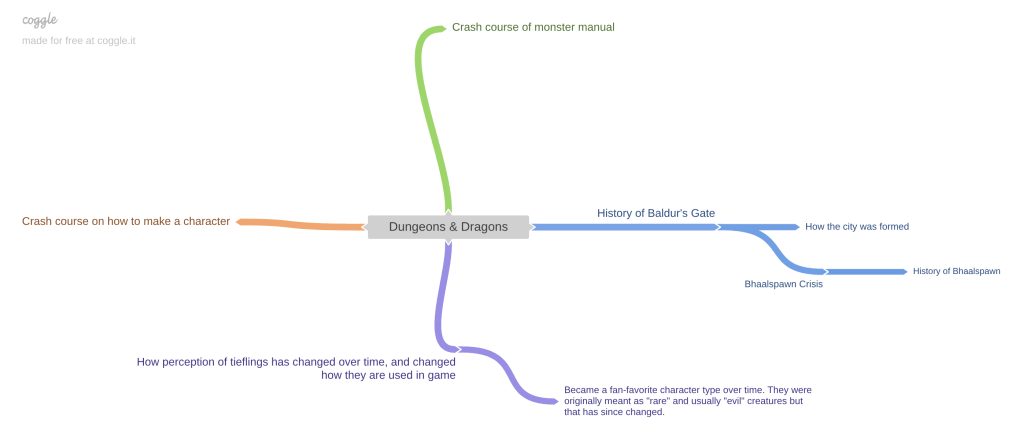
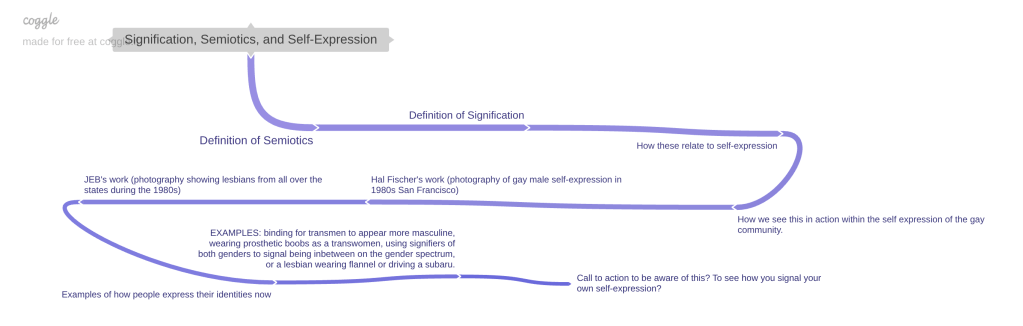

At first, after completing the mind maps, I was not sure which one to go with. I really liked all the ideas, but I wasn’t sure which one would be most successful for my first podcast. As a result, I approached the creative brief section of the podcast-preplanning document by filling it out for all three ideas. Once I got to the Questions/Notes and Scripting sections, I decided to focus on one idea.
The podcast idea that I felt had the most solid thread of thought for me was semiotics, signification, and self-expression. This is a subject I have been studying for a while and am very intrigued by. I will be able to write a script about this topic more easily and feel confident in my delivery. For my script, I made a detailed outline to help guide me. I chose this method of scriptwriting because I know myself well enough to know I need detailed notes, but I also wanted to avoid sounding too scripted.
 Home
Home 