Last week, we briefly analyzed how the social media strategy for Build-A-Bear Workshop is successful. This week, we will take another, more in-depth look at their social media strategy and suggest ways to strengthen it.
As previously discussed, Build-A-Bear is a company that sells stuffed-animal skins for customers to stuff and personalize with clothing and accessories, allowing them to build their own bear. With the prevalence of social media today, Build-A-Bear is one of many companies that have joined the world of social media advertising through its own pages.
In the case of Build-A-Bear, its objective is to inform potential customers about the different bears, clothing, and accessories it offers, and to encourage them to visit stores or buy online. Their strategy to achieve this goal is to promote their products through organic social media advertising by posting videos and photos advertising their bears.
Metrics Analysis
To review Build-A-Bear’s metrics again, I used a different metrics analysis tool, Sprout Social. This tool allows the user to set a date range to pull data from, so the range was set from Jan 1st to Dec 31st, 2025, to provide a large amount of data for the tool to use.
Within the provided time frame, Build-A-Bear averaged about four posts per week, with each post including about three videos and one photo. The average total public engagement in 2025 was 31,178, with an average of 13,854 and 325 comments. This shows that Build-A-Bear performs well, but there is a significant difference between their average likes and comments, with likes always significantly higher.
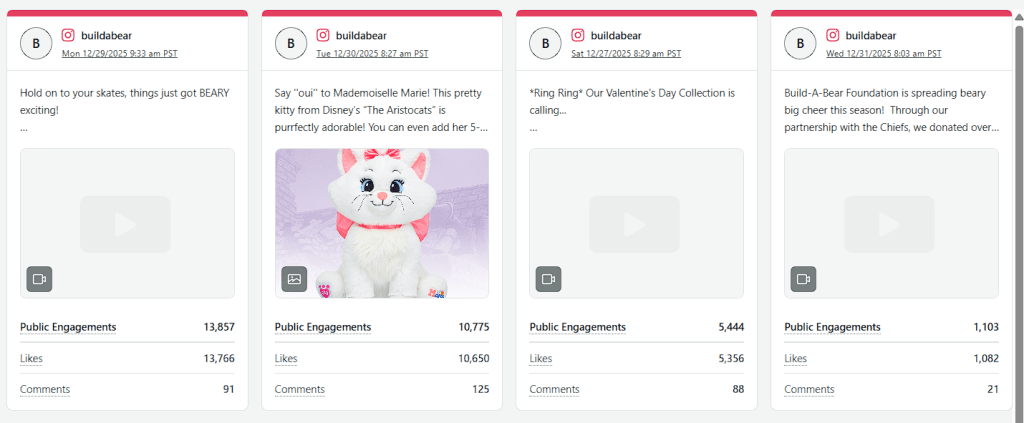
The best-performing post Build-A-Bear had been an Instagram reel of a bunny Build-A-Bear in an ice-skating uniform skating around. This is a collaboration post with the US Figure Skating Championships. The darling video has 13,857 engagements, 13,766 likes, and 91 comments.
The second-best-performing post from Build-A-Bear is a photo post advertising a bear collab with Disney to create Marie from the Disney movie The Aristocats, an online-exclusive. This post has 10,775 engagements, 10,650 likes, and 125 comments.
The third best-performing post is a reel advertising their Valentine’s collection. This post has 5,444 engagements, 5,356 likes, and 88 comments.
The fourth-best-performing post is yet another collaboration, this time between Build-A-Bear and the Kansas City Chiefs, to donate to Toys for Tots. This post has 1,103 engagements, 1,082 likes, and 21 comments.
Noticed Trends
A trend among the best-performing Build-A-Bear posts is that three of the four are collaborations. This trend suggests that collaborating with other brands and businesses could be a strategy to further increase engagement. This attracts not only Build-A-Bear fans but also fans of the brands they collaborate with.
Another trend among the four best-performing posts is that three are also videos. The significance is that posting more videos could be another strategy to further increase engagement.
A different trend across all four best-performing posts is a significant difference between the number of likes and the number of comments. This means customers are indeed viewing and enjoying the posts. However, customers do not seem to be staying engaged for long. It takes just moments to like something before moving on.
Attention plays an important role in creating organic content because engaging content must capture and retain the viewer’s attention. This is because there needs to be some value for the viewer. Because attention is a finite resource, we have only so much to spare (Yakob, 2022). This is why people will scroll past videos they do not find entertaining. Though there is no single surefire way to retain viewer attention, Build-A-Bear has done so successfully in the past.
New Strategy
While Build-A-Bear’s current social media strategy is highly successful at getting likes, the values of its other engagement metrics are much lower. With the following tactics, their social media might drive more engagement through comments and shares.
A tactic that Build-A-Bear has used before that could be used more is creative storytelling. For example, the video of the bunny skating, though short, tells a cute story: she gives a great skating performance, and then the audience cheers as prizes are thrown at her feet. Creative storytelling like this can foster an emotional connection with viewers, thereby keeping their attention (Thony, 2024). Because this post was the #1 best-performing, it successfully retained attention through storytelling. Creative storytelling is not the only way to retain audience attention. This could not only get more likes but also more shares, as viewers want to share the story with others.
A tactic Build-A-Bear does not seem to engage in much is user-generated content; despite this, it is something they could benefit from as well. User-generated content, such as customer testimonials and stories, can help build authenticity and encourage participation (Thony, 2024). They could ask users to share stories about making their first bear or a favorite bear. They could host a contest in which they ask users to submit ideas for potential bears and post the ideas they receive. Then there could be a vote about which bear, or a few bears, should be sold in stores. These are just a few ideas, but there is much Build-A-Bear could do with user-generated content.
Conclusion
While Build-A-Bear’s current social media strategies have certainly shown success in their metrics, there could still be a better balance in their user engagement. By sharing stories and encouraging users to share their own, they could get more users to engage with their posts beyond just liking them. This could create greater endearment toward the brand and, in turn, lead to more sales conversions.
References
Thony, S. L. (2024). Chapter 5: Social Media Marketing. In The Marketing Campaign Playbook: A Step-by-Step Guide for Entrepreneurs, Marketers & Small Business Owners. essay, STK MTK Entertainment.
Yakoub, F. (2022). Chapter 5: The Spaces Between. In Paid Attention: Innovative Advertising for a Digital World (2nd ed., pp. 72–83). essay, Kogan Page.
 Home
Home 