In addition to traditional advertising, a brand can advertise on social media through influencer marketing. This refers to any time a brand or company funds or collaborates with a social media influencer to promote itself. It is not enough to simply hire an influencer; a clear strategy is needed to ensure campaign success. To see how a collaboration between a brand and an influencer can be used strategically to achieve a brand objective, we will discuss a social media influencer strategy for Daisy Doodle.
Daisy Doodle is a hypothetical character brand inspired by Hello Kitty, Miffy, and my childhood dog, a goldendoodle named Daisy. The value that she is meant to bring to her audience is joy through digital content such as animated videos, comics, and merchandise. Rather than focusing on Daisy Doodle’s early reach, we will assume it is a more established brand at this point.
CAMPAIGN GOAL
While the main campaign goal will remain brand awareness, other goals now include increased engagement to foster community and conversions to merchandise sales.
A method for advertising is to collaborate with a social media influencer. The benefit of this is expanding the reach and impact of the social media campaign by building credibility and driving results.
STRATEGY
According to The Marketing Campaign Playbook by Sharon Lee Thony, there are three identifying steps in identifying and collaborating with an influencer for your industry:
- Choosing the right influencer, one who aligns with brand values and whose audience overlaps with the brand’s target audience.
- Building relationships with influencers based on mutual respect and trust before discussing collaboration opportunities.
- Working with influencers to create content that feels authentic and resonates with the audience. This is important because authenticity is key in maintaining credibility and trust (2024).
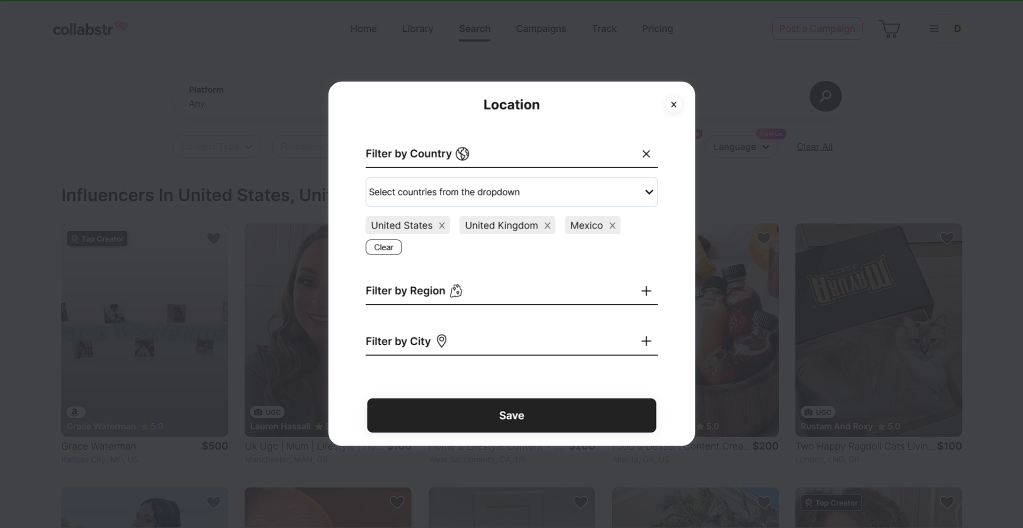
Using these rules, and one of the various digital tools online that can be used to identify an influencer who would work with a company’s goals. One such tool is Collabstr. Using Collabstr, I started my search by setting the location parameters to align with Daisy Doodle’s target audience. At first, I selected all three locations to cast as wide a net as possible, but that was too wide. So, I reset it to just the U.S., and set the follower count parameters to 10k min followers and 1,000,000+ max followers.
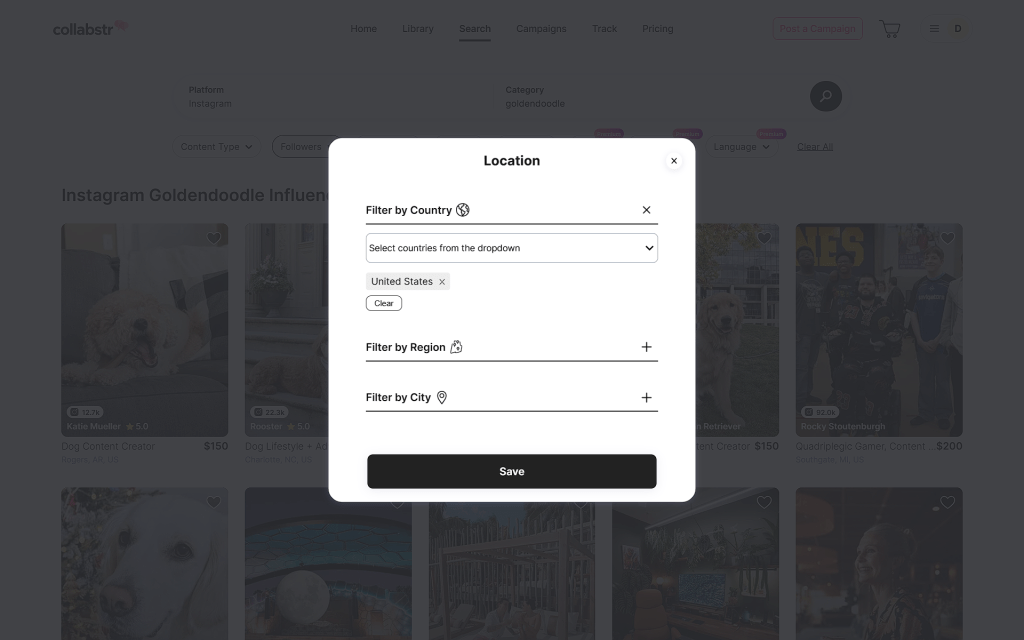



At first, I searched the combined categories of Animation and Animals & Pets, but did not find a matching influencer in the results. So next, instead, I searched just Animation. From this, I found an influencer who aligns with Daisy Doodle’s brand values.
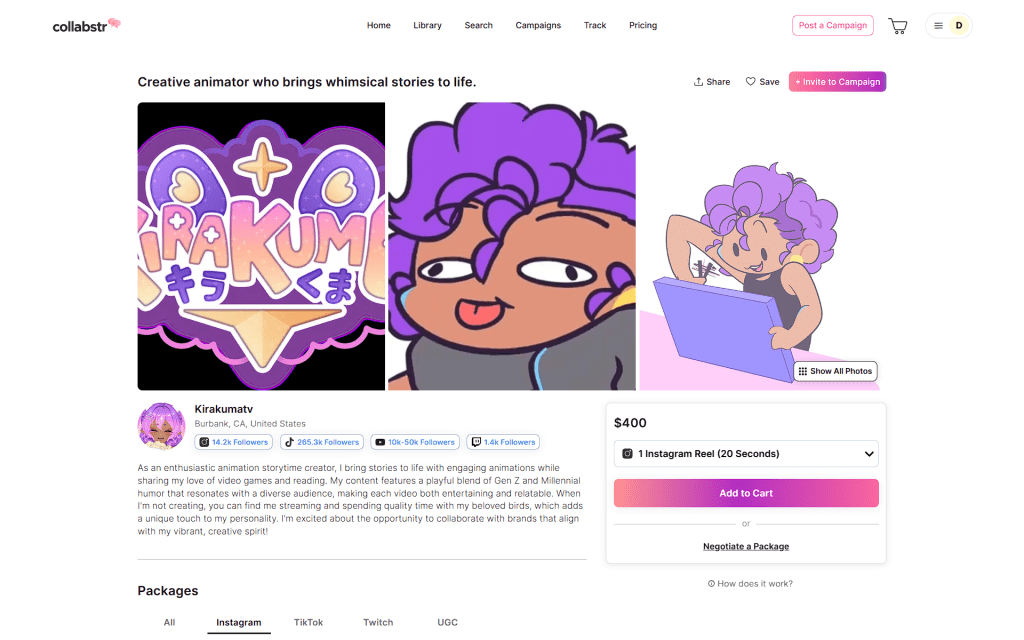
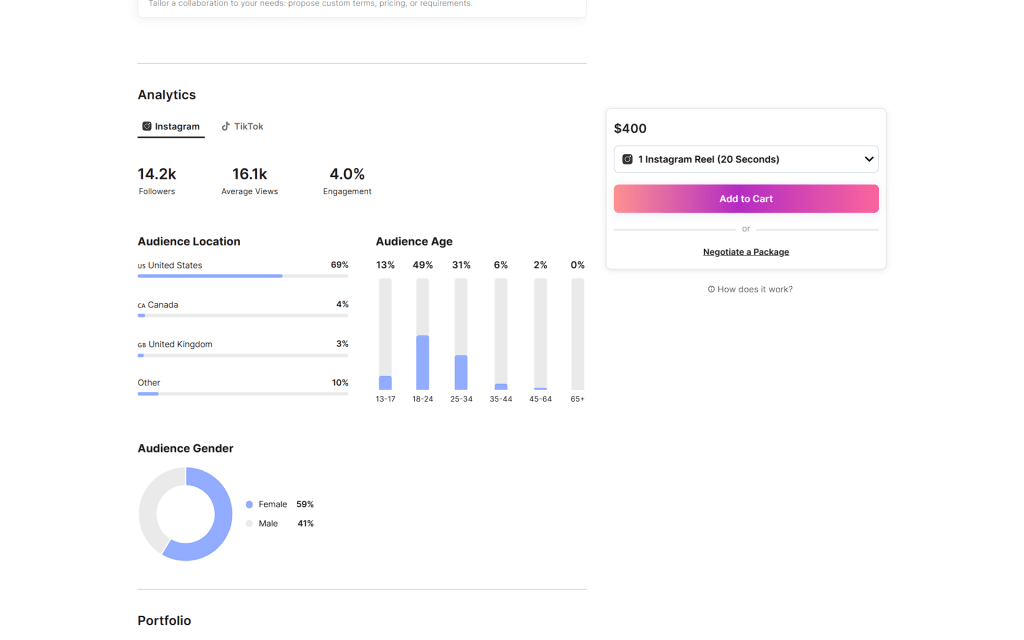
The first influencer is an animator on Instagram, @KiraKumaTV, who creates engaging animations that bring stories to life and combines Gen-Z and Millennial humor. KiraKuma is a micro-influencer with 14.2K followers, averages 16.1k views, and a 4.0% engagement rate, with an audience that is mostly in the U.S. Other than location, the audience overlap is age, with teens to folks in their 40s, and interests in animation. Both KiraKuma and Daisy Doodle want to create engaging animations for their audiences, aligning with Daisy Doodle’s brand values.
They could be paid to create a 20-second reel animation, co-created with them and the Daisy Doodle animators, to promote Daisy Doodle’s animated shorts and other digital content. This will help build brand awareness for Daisy Doodle and hopefully drive engagement on the Daisy Doodle Instagram page.
After finding an animator, I decided to switch to the other category I had previously tried, just searching Animals & Pets, yet quickly found this was too broad. It showed me all sorts of pet influencers. So instead, I searched for the key term “golden doodle” to find a goldendoodle-focused influencer. Being this specific had much better results.
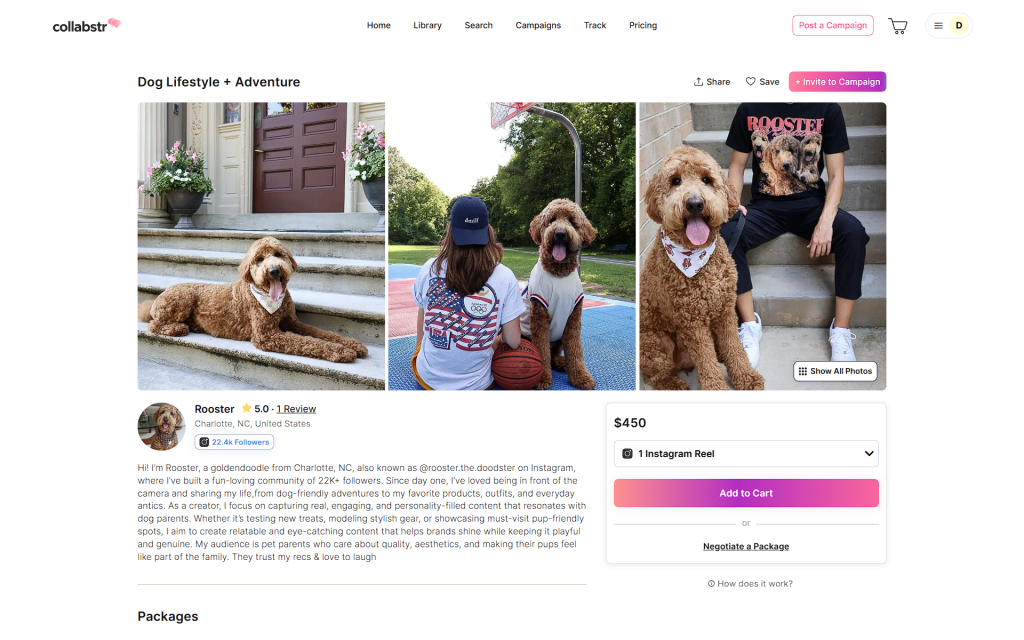
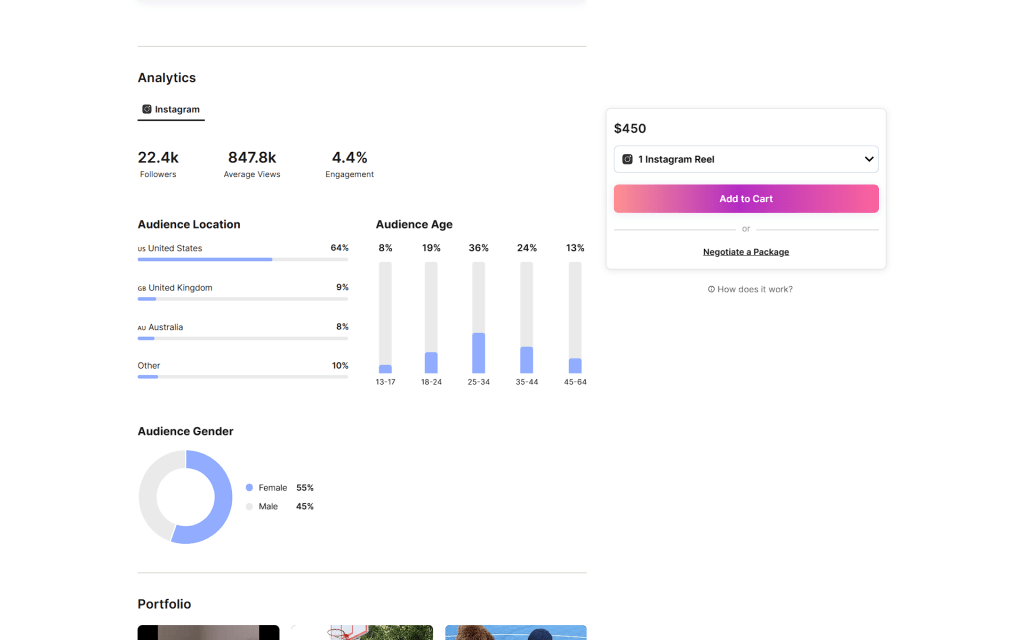
The second influencer I found is a goldendoodle named @Rooster.The.Doodle on Instagram. They create engaging content for pet owners that showcases a range of treats, gear, and “pup-friendly” spots. They are another micro-influencer with 22.4K followers, 847.8 K views, and a 4.4% engagement rate. Their audience is also mostly based in America. Audience overlap also occurs with age, as Rooster’s audience is mostly folks in their 20s to 40s. Also, there is an overlap between audiences interested in golden doodles. A brand value of Daisy Doodle is appreciating the breed of golden doodles, and this influencer aligns with that.
Rooster could be paid to create an Instagram Reel showcasing various bits of Daisy Doodle merch to raise brand awareness of Daisy Doodle and the available merch that showcases the wonderfulness that is Daisy Doodle, and hopefully drive more sales.
All these influencers would post the collaborations on the platforms that they already use: Instagram. The success of these collaborations can be measured by tracking different key performance indicators (KPI).
PERFORMANCE MEASUREMENTS
Since all will be posted on Instagram, Instagram Insights can be used to track metrics for each influencer campaign. The metrics, or KPI, that will be monitored to measure success include engagement rate, reach & impressions, click-through rate (CTR), and earned media value.
Engagement rate measures audience interactions relative to follower count. On Instagram Insights, this will be called “Interactions”. This will show how many people interact with the influencer’s content post relative to the influencer’s follower count. This will show how many of the influencer’s followers are responding to Daisy Doodle’s advertising with the influencer.
Reach & impressions track the number of people who see influencer content. For Instagram Insights, this will specifically be “Views.” This will show exactly how many sets of eyes are seeing what the influencer is posting. While this contributes to the engagement rate, it is a more specific metric.
CTR shows how many users take action after seeing influencer content. This can also be seen under “Interactions” on Instagram Insights. For Daisy Doodle, this would be clicking through to Daisy Doodle’s own Instagram and other social media.
Conversion rate is the percentage of users who complete a desired action; for Daisy Doodle, it’s the percentage of users who view and follow the Daisy Doodle page. This can be found by looking at “Followers” and subtracting that number from “Views”. Then you’ll have an estimation of how many folks are following instead of just moving on after viewing.
EMV is the monetary value of influencer-generated exposure compared to traditional advertising. This will show how successful the influencer content ad campaign is in comparison to the traditional advertising campaign efforts that Daisy Doodle is putting forth. While Instagram does not provide this metric directly, it will provide the data necessary to measure the EMV with the following equation, according to Launch Metrics:
EMV = Reach X Cost Per Thousand X Engagement Rate X Adjustment Factor
Or a tool like Hype Auditor’s Free Influencer Marketing EMV Calculator could be used too.
If all these metrics are high, it shows the influencer’s content is successful in achieving the campaign objectives of brand awareness, increased engagement, and higher merchandise sales. However, challenges may arise before a campaign succeeds. Luckily, those challenges do not come without solutions.
CHALLENGES & SOLUTIONS
A challenge that may arise when measuring the success of an influencer collaboration is low metric results. A low engagement rate means the influencer’s content is not grabbing the audience’s attention. This could be solved by going back to the drawing board with the creator to create more engaging content for the audience.
Low reach & impressions, then not a lot of people are seeing it and reacting to it. While this could be solved by reworking the content, it could also be addressed by re-evaluating how to make it more interesting. It could also be solved by re-evaluating hashtags and keywords used to reach more eyes.
Low CTR means people are not clicking through. This could be solved by creating a stronger payoff for clicking through, tempting users more. A low conversion rate means people are not completing the desired action, and could be solved in the same way.
Low EMV means the monetary value of influencer advertising is not higher than that of traditional advertising. This could be addressed in the same way as the engagement rate, making the content more engaging for the audience.
Another challenge in measuring the success of an influencer collaboration is a lack of mutual respect and trust between the brand and the influencer. This can be addressed before continuing with collaborative content. This is because authenticity is key to maintaining credibility and trust; without trust between the brand and the influencer, there will be no authenticity. So, the collaboration will not be successful.
CONCLUSION
By collaborating with an influencer, a brand can tap into their audience to achieve a brand objective. In the case of Daisy Doodle, collaborating with an animator, illustrator, and even goldendoodle-appreciation influencers could help tap into that audience to increase brand awareness, increase engagement, and drive merchandise sales by working with an influencer who aligns with the brand. However, it is not enough to just have an influencer put in a good word for your brand; there needs to be an authentic relationship between the influencer and brand for the campaign to be successful.
REFERENCE
Pennings, E. (2025, September 23). How to use Instagram Insights (in 9 easy steps). HubSpot Blog. https://blog.hubspot.com/marketing/how-to-use-instagram-insights
Team, L. C. (2026, February 11). How to measure earned Media Value: AVE, EMV and MIV explained. Launchmetrics. https://www.launchmetrics.com/resources/blog/measure-earned-media-value#:~:text=How%20to%20Calculate%20Earned%20Media,e.g.%2C%201%E2%80%932)
Thony, S. L. (2024). Chapter 10: Influencers and Partnerships. In The Marketing Campaign Playbook: A Step-by-Step Guide for Entrepreneurs, Marketers & Small Business Owners. essay, STK MTK Entertainment. Thony, S.L. (2026). Module 6: Live Session Notes. [PowerPoint Slides]. https://docs.google.com/presentation/d/1wNZxoXf5OmOawqsuwYPNuGj6zahHpbev3bwdbGMQw7U/edit?slide=id.gf5520038ca_0_356#slide=id.gf5520038ca_0_356
Thony, S.L. (2026). Module 6: Live Session Notes. [PowerPoint Slides]. https://docs.google.com/presentation/d/1wNZxoXf5OmOawqsuwYPNuGj6zahHpbev3bwdbGMQw7U/edit?slide=id.gf5520038ca_0_356#slide=id.gf5520038ca_0_356
 Home
Home 