Stop-Motion Animation is animation created by taking one photo at a time and stringing them together in sequence to simulate movement. It is a way to bring inanimate objects to life on camera. It is an animation technique used in many movies over the years. Both to bring specific characters to life, like with King Kong, or to bring a whole world to life with full-length stop-motion films. Since the beginning of stop-motion, the medium has undergone a good deal of change. The following graphs venture to visualize how it has.
How Stop-Motion Films Have Changed Over Time
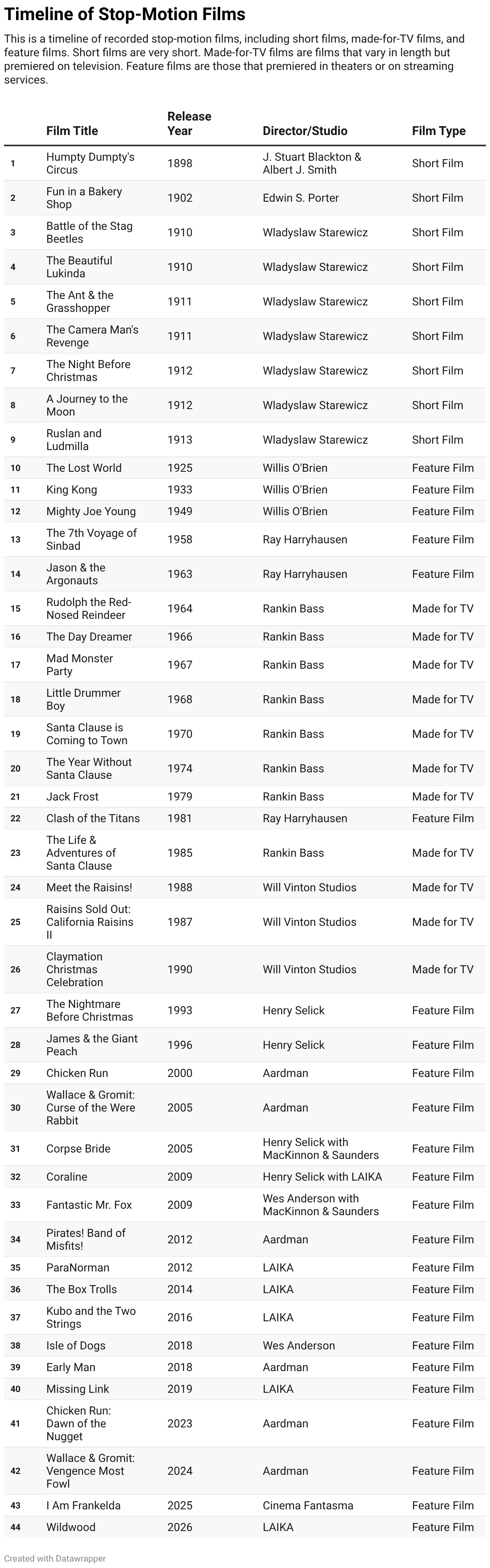
Here we highlight key stop-motion films, beginning with the earliest known, Humpty Dumpty’s Circus, made by Albert J. Smith and J. Stuart Blackton, the founders of Vitagraph Studios. Humpty Dumpty’s Circus was the only stop-motion film they made, and no copies of the original footage survive. It was made using toys belonging to one of the directors’ children. The second stop-motion film, Fun in the Bakery Shop, was directed by Edward S. Porter and depicts a baker shaping celebrity busts from dough. Both earliest stop-motion films were short films.
There weren’t any more stop-motion films until animator Wladyslaw Starewicz began making stop-motion short films using dead bugs. He made a total of eight stop-motion films. The next example of stop-motion in film appears in monster movies, with directors like Willis O’Brien bringing monsters to life on camera alongside modern actors, such as King Kong in the original King Kong film. While these feature films (meaning they premiered in theaters or on a streaming service in the modern day) include stop-motion segments, the entire films are not stop-motion. All of O’Brien’s films, as well as Ray Harryhausen’s films, feature real-life actors and rely on them for most of the film. The stop-motion is edited in to interact with the actors. There will still be time before a feature film is fully stop-motion.
In between Harryhausen’s last two films, Rankin-Bass emerges. Rankin-Bass is a stop-motion studio that specializes in holiday-themed made-for-TV specials (meaning it was made to premiere on television). If you grew up in America, there is a solid chance you watched one of their specials during the holiday season. They continually made films from 1964, starting with Rudolph the Red-Nosed Reindeer, until 1985, when they made the Life and Adventures of Santa Claus. Other animation studios, such as Will Vinton Studios and Aardman, came along and began making made-for-TV and short films as well. Will Vinton Studios went into advertising, doing the Noid commercials for Domino’s during the 90s, and even did an M&M commercial series. Aardman has had many long-standing stop-motion series as well, such as Morph (1976-now), Creature Comforts (1989-2011), Shawn the Sheep (2007-now), Timmy Time (2009-now), and The Very Small Creatures (2021-now). Since these are not actual films, they were not included in the timeline but are still worth mentioning.
There wasn’t a full-length stop-motion film until 1991, with the release of The Nightmare Before Christmas. From then on, plenty of full-length stop-motion feature films followed, with Henry Selick continuing to make Corpse Bride and Coraline with different studios. Afterward, both studios continued to make more stop-motion films, with LAIKA even specializing in stop-motion. As recently as 2025, a new stop-motion studio emerged: Cinema Fantasma, debuting their first film, I Am Frankelda.
All the following graphs are based on information from the previous timeline. A focus will be placed on full stop-motion work, with data available to show how stop-motion has changed.
Years of Film Production for Stop Motion
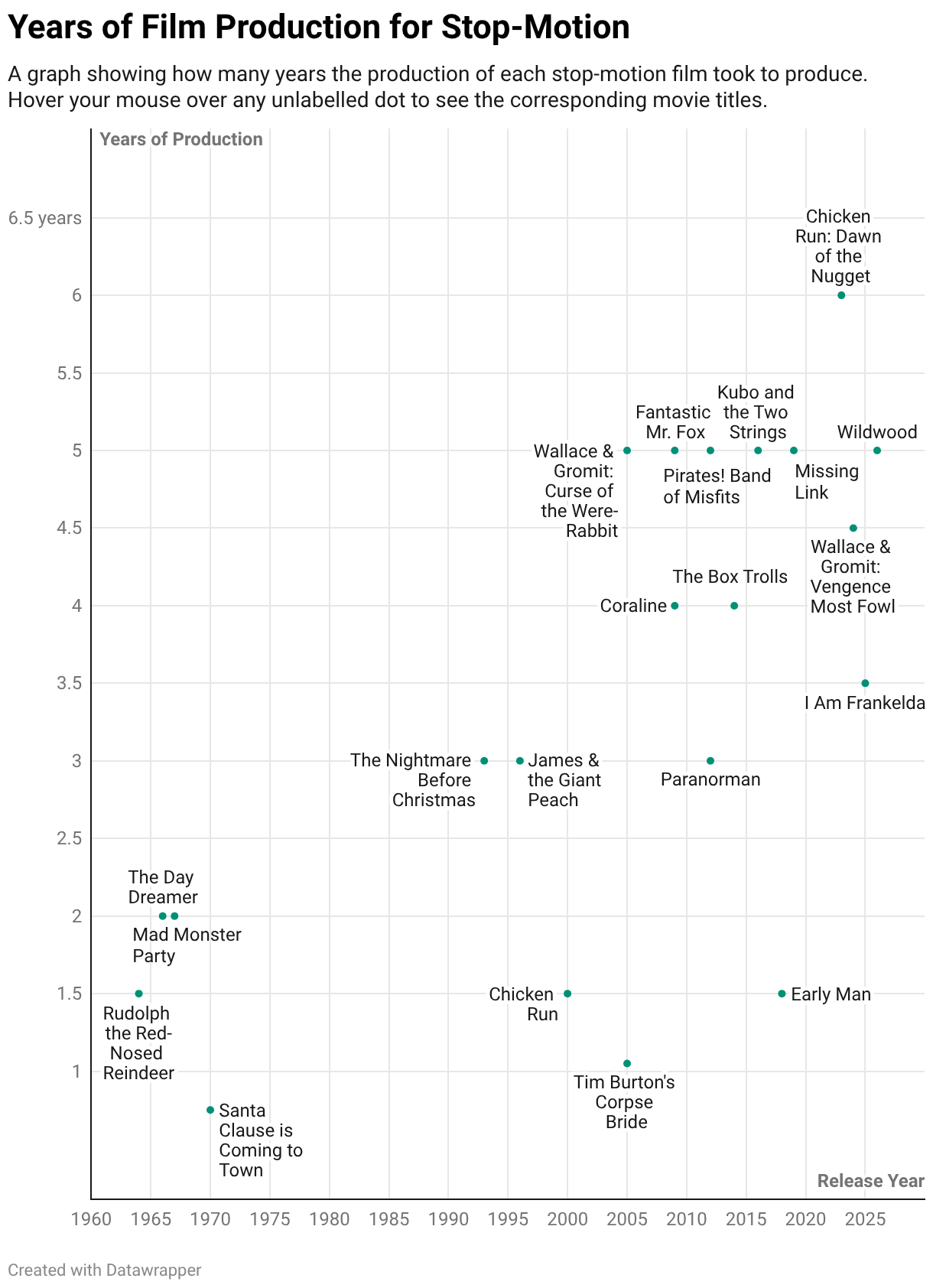
Based on publicly available information, this shows the total number of production years for each fully stop-motion film. This information was not available for all Rankin Bass specials, but it was available for all the feature films. This shows that stop-motion is a time-consuming process, which is why there can be such a long gap between a studio’s films.
Length of Stop Motion Films
View in Datawrapper
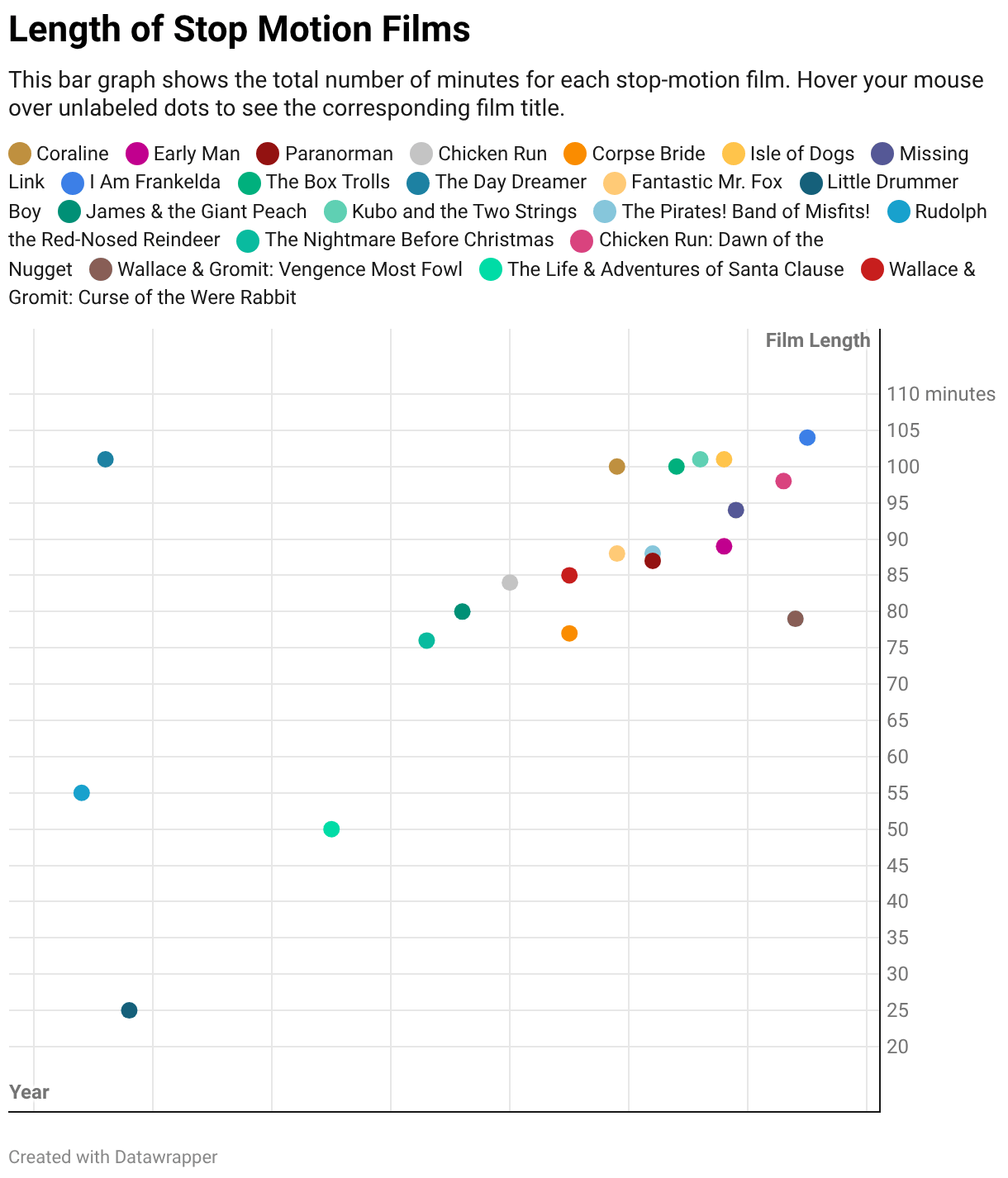
This displays the total length, in minutes, of all films listed within the timeline. The shortest films of the made-for-TV movies are the California Raisins Specials and the Claymation Christmas Special at 24 minutes, while the longest is The Daydreamer at 101 minutes. This is because made-for-TV movies are designed to fit into normal television viewing schedules. So, they need to fit cleanly within time allotments across different channels. However, feature films can be much longer. Thus, the shortest feature film is The Nightmare Before Christmas at 76 minutes, while the longest is Wildwood at 139 minutes. This shows that the movement of stop-motion films to the big screen has enabled them to run much longer than before.
Film Length, Frames per Second, and the Total Number of Frames for Stop-Motion Films
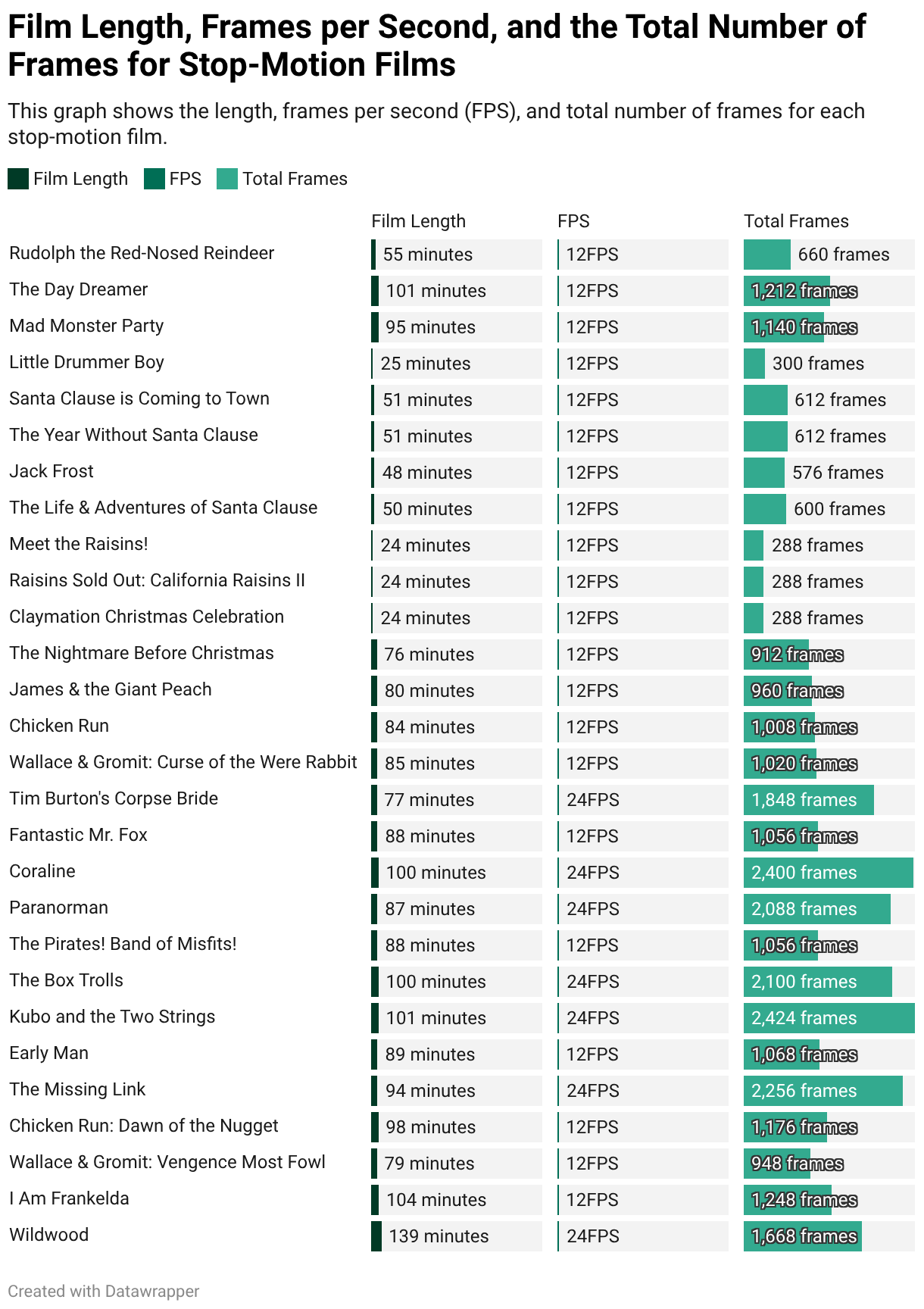
This graph shows the length of each film, its frame rate, and the resulting total number of frames. For a long time, the industry standard for stop-motion was to animate on-twos, meaning 12 frames were captured, requiring the puppet to be repositioned 12 times. Alternatively, there is animating on-ones, which involves capturing 24 frames per second, resulting in the puppet being repositioned 24 times. While animating on-ones is a lot more work, it creates smoother movement than on-two animation. It is the industry standard to primarily use on-two animation to reduce labor, and to use on-one animation only in specific sections to create smoother movement. It is not until Coraline that on-one animation is used as the primary method of animation, instead using on-twos only in certain sections to stylistically achieve more jerky movement. This shows a change in methods for stop-motion animation over time.
Stop Motion Film Budgets in Order, From Highest to Lowest
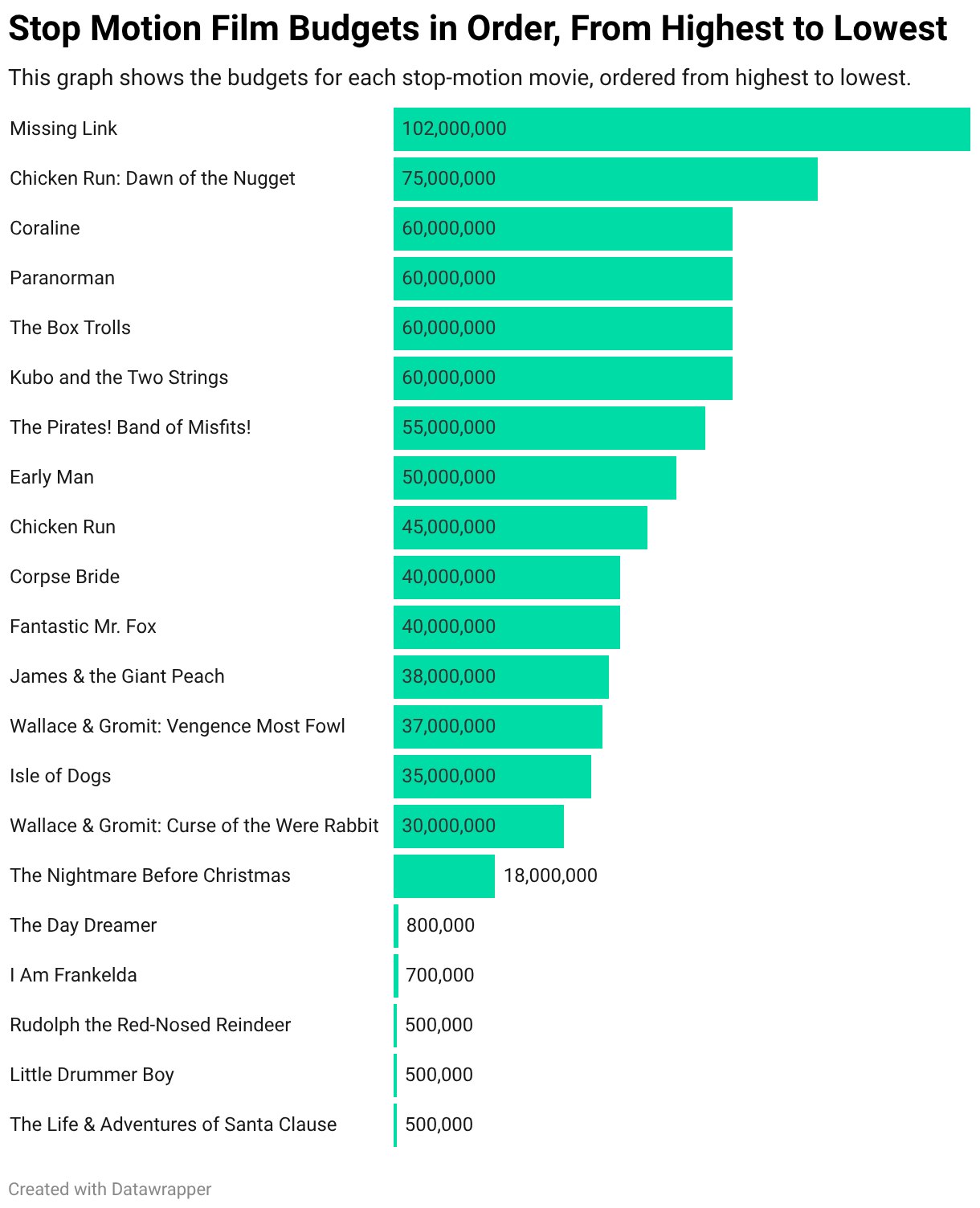
This graph shows the allotted budget for each film listed previously, when applicable. For most Rankin-Bass films, all Will Vinton Productions films, and LAIKA’s newest film Wildwood budgets were not publicly available, so they were not included. The largest budget that Rankin-Bass had was also for their longest film, The Daydreamer, at $800,000. While the largest budget for their longest film, The Daydreamer, was $800,000, this shows that the bigger the budget. Interestingly, the LAIKA film with the biggest budget, and ultimately the biggest budget of them all, is Missing Link at $102,000. Though this is not the longest LAIKA film, Kubo & the Two Strings is the longest at 101 minutes with a budget of $60,000. This graph shows how budgets for stop-motion have increased, allowing more work to be done on them. This can be seen by the fact that the largest budget for Rankin-Bass also belonged to their longest film. Presumably, more work went into it than others, as it would have required more frames. However, Missing Link has the largest budget, but is 5 minutes shorter than the longest LAIKA film. This is because more money went into the sets and puppets than other films. This will be detailed more in the next graph.
How Many Puppets and 3D Printed Faces LAIKA Has Made for Each Movie
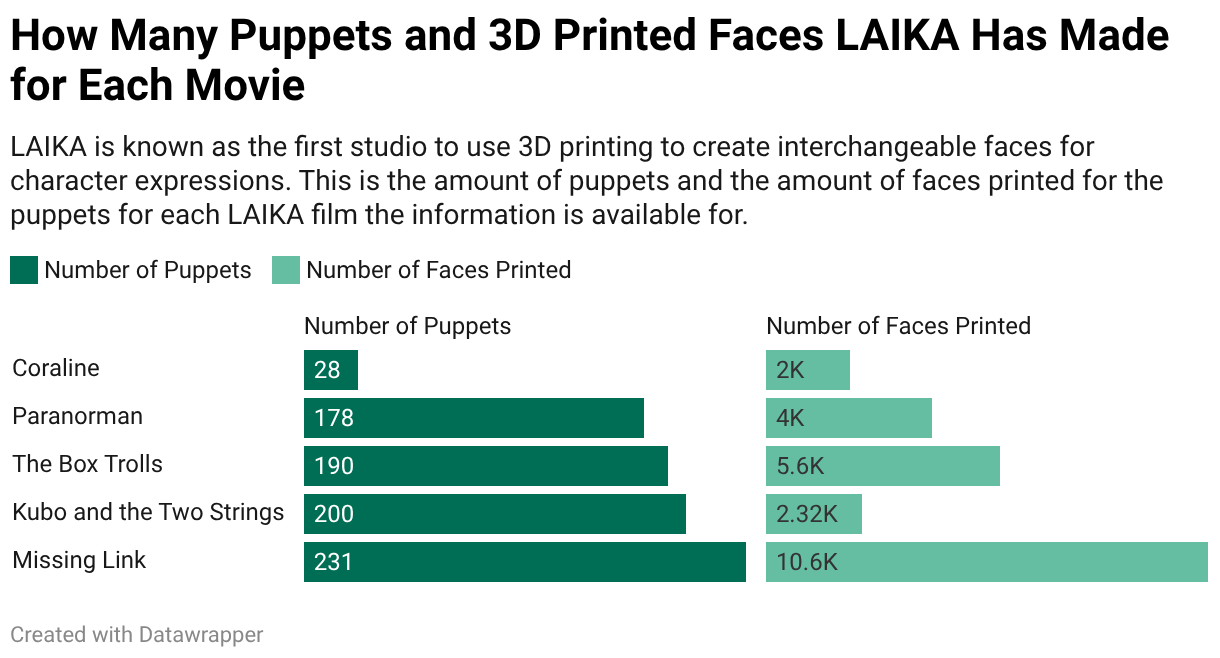
This graph shows the number of puppets created for LAIKA, the number of faces it has 3D-printed for them, and the required budget. This shows that animation methods are continually evolving. While LAIKA spends more time making films, they also reduce their workload by having their characters’ faces 3D-printed rather than hand-sculpting them as in traditional methods. Missing Link had the largest budget, so the money was put towards making the most puppets and the most 3D-printed face changes for them at 231 puppets and 106,000 printed faces. However, putting so much money into puppets and 3D-printed faces does not guarantee success.
Budget, Box Office Sales, Physical Disc Sales, and Return on Investment for Stop Motion Movies
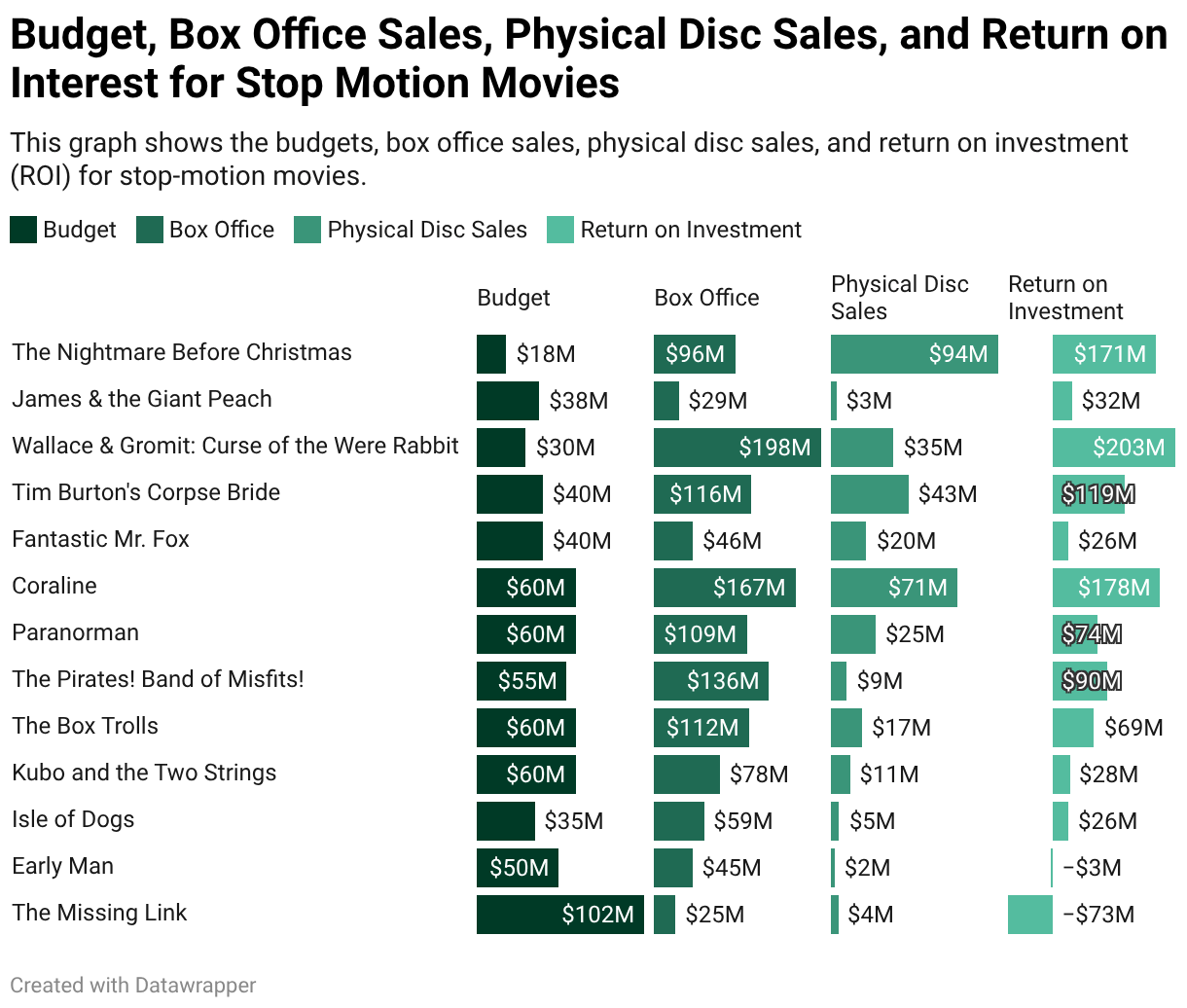
This shows the budget for each film, along with box office, DVD sales, and overall return on investment (ROI), which is the amount of money returned to the studio relative to the cost of creating the movie. This shows that just because there is a big budget, it does not guarantee success. Aardman and LAIKA both had the largest budgets for Early Man and Missing Link, yet both yielded negative ROIs, with Early Man at -$3,000,000 and Missing Link at -$ 73,000,000. This shows that investing money in a movie does not guarantee success.
Stop Motion Films with the Highest ROI
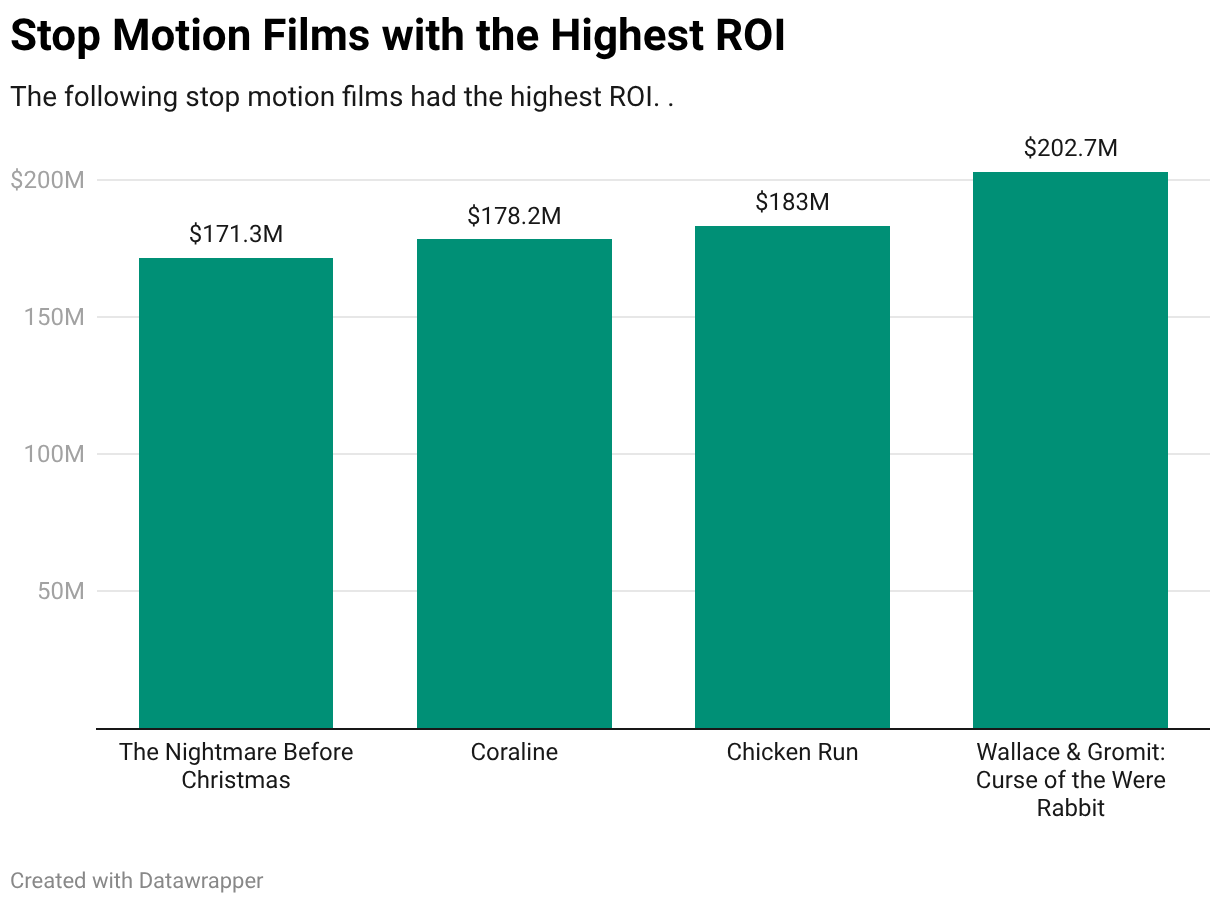
This graph simplifies the ROI data from before down to the films with the highest ROI. This shows which stop-motion stories were the most popular with audiences. The movie with the highest ROI is Wallace & Gromit: Curse of the Were Rabbit at $202,734,492, and the film with the lowest among the highest is The Nightmare Before Christmas at $171,300,092. All of these films have dark or spooky plots. The Nightmare Before Christmas is about a Halloween skeleton stealing Christmas. Coraline is about a little girl who finds a magical world that turns out not to be what it seems. Chicken Run is about chickens trying to escape their chicken farm to avoid becoming chicken-potpies. Wallace & Gromit: Curse of the Were Rabbit is about the titular character Wallace becoming a, you guessed it, Were Rabbit. This shows that stop-motion has come a long way from shorts about reindeer with shiny noses.
How Many Stop-Motion Movies Film On Twos versus On Ones
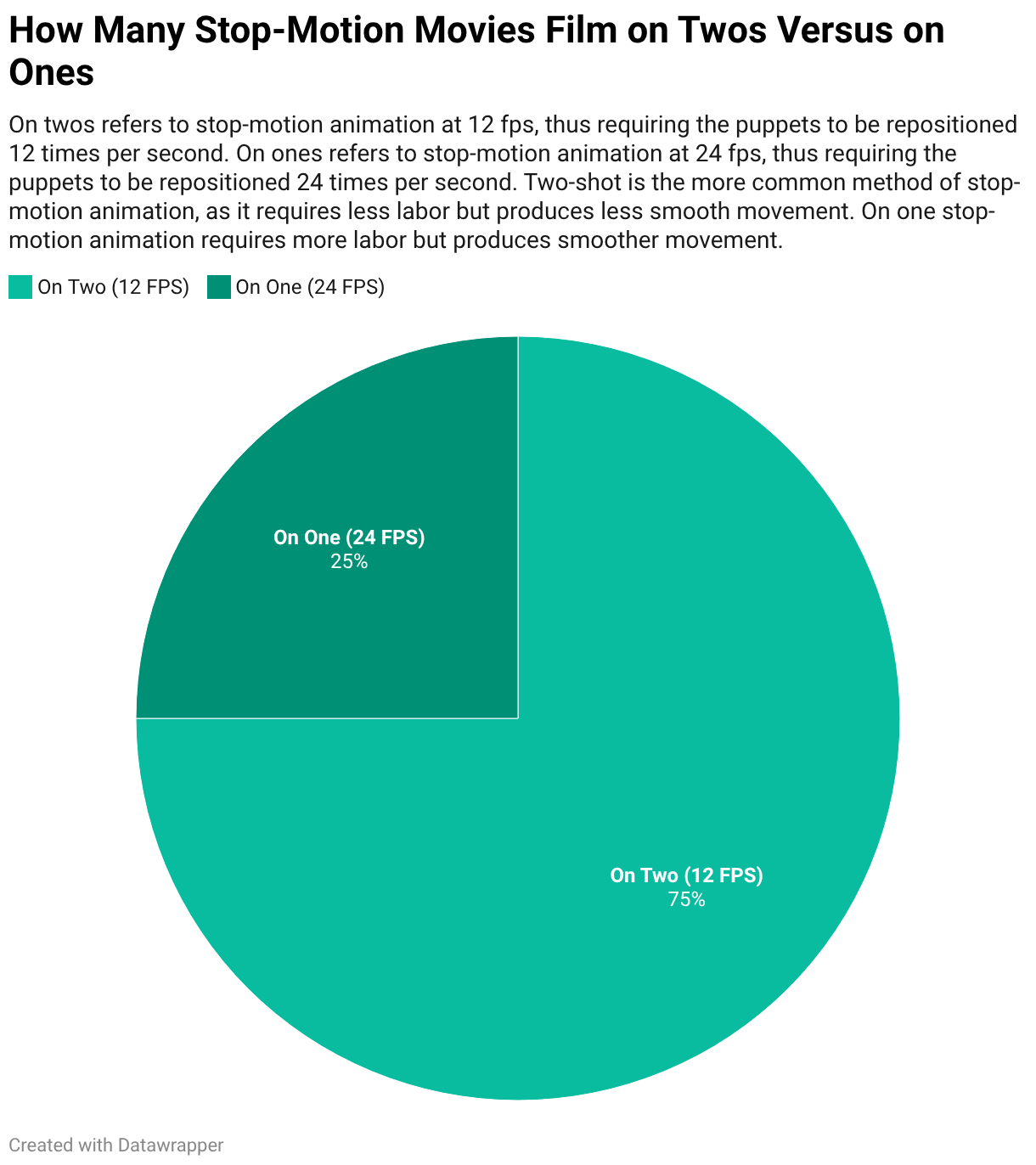
Based on available data, this shows how many films use on-two stop-motion animation versus on-one animation. On-two animation involves taking 12 photos in 1 second of animation, requiring 12 position changes for a puppet and resulting in more jerky, stylized animation. One-on-one animation involves taking 24 photos in 1 second of animation, which requires 24 position changes for a puppet and results in smoother movement. This graph shows that animation methods are moving towards creating more fluid movement, using on-two animation only for stylistic choices, as with Aardman, which continues to use that method. Not only has the total number of stop-motion films grown, but so have methods.
Altogether, all these graphs reflect how stop-motion films have changed over time.
References
A brief history of stop-motion. Focus Features. (n.d.). https://www.focusfeatures.com/article/a__brief_history_of_stop_motion
Canon Europe. (n.d.). The making of Wes Anderson’s Isle of Dogs – filmed on the canon EOS-1D X.
https://www.canon-europe.com/pro/stories/making-isle-of-dogs
Film, TV & Games. Aardman. (n.d.). https://www.aardman.com/film-tv-games
Home. Box Office Mojo. (n.d.). https://www.boxofficemojo.com
Hidden worlds: The Films of LAIKA. Hidden Worlds: The Films of LAIKA. (n.d.). https://www.laikahiddenworlds.com
John. (2023b, September 28). Stop motion animation: A Brief History. Central Rappahannock Regional Library.
https://www.librarypoint.org/blogs/post/stop-motion-history
Picón, V. (2022, April 11). A brief overview of the history of stop-motion animation. Herald.
https://blogs.mcm.edu/herald/2020/11/03/a-brief-overview-of-the-history-of-stop-motion-animation/
Stopmo. (2016, June 4). The history of Stop Motion – in a Nutshell. Stop Motion Magazine.
https://stopmotionmagazine.com/history-stop-motion-nutshell/
The Enchanted World of Rankin. Bass. (n.d.). http://www.rankinbass.com/
The financial operating system for production teams. Saturation. (n.d.).
https://saturation.io
The Movie Database. The Movie Database (TMDB). (n.d.). https://www.themoviedb.org/?language=en-US
Where Data and the Movie Business Meet. The Numbers. (n.d.) https://www.the-numbers.com
Will Vinton Studios Gallery: The Clay and stop Mo. Animate Clay. (n.d.). https://www.animateclay.com/will-vinton-studios-gallery