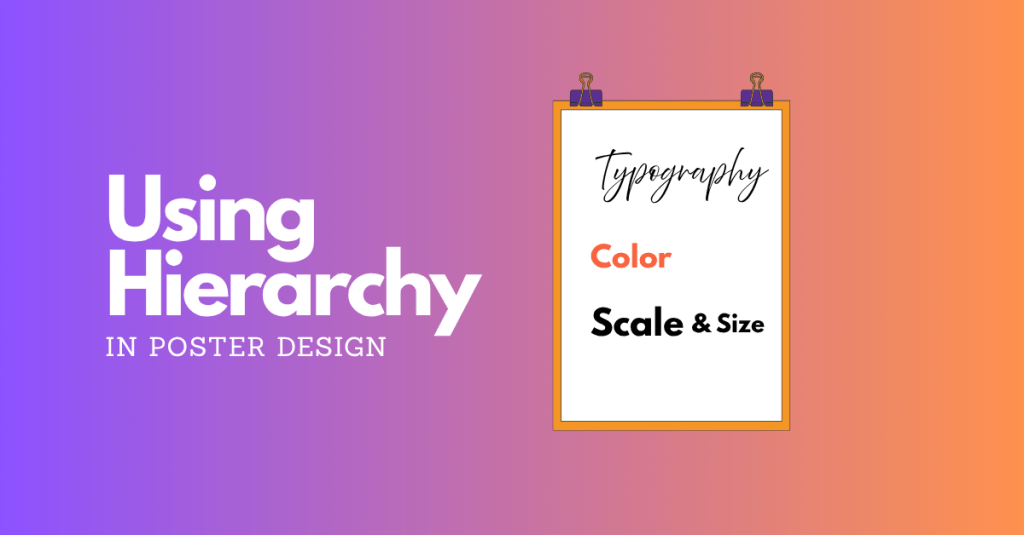
When creating a poster design, whether for an event or a movie, it is important that the intended message is conveyed. One way a designer can ensure their message is clear is by using hierarchy.
Hierarchy is defined as an arrangement that shows the relative importance of different elements. This is done effectively using typography and color, as well as manipulating the size and scale of different elements. By effectively using hierarchical design, a designer can ensure that the information they want to communicate is conveyed clearly.
Using Typography
Typography can guide readers on where to start and finish, and help them easily find information. One way to do this is through ranked text. When styling text, it is crucial to ensure that the styling matches the text’s importance. Otherwise, viewers might focus on the wrong information or completely miss the information originally intended to be conveyed. Therefore, it can be helpful to list the different types of text in your design and rank them by importance.
Layouts commonly have at least three levels of text, while complex layouts can have more. Level 1 is the highest and is used only for the most important text, such as headings or titles. Level 2 is the next rank down, and includes subheadings and introductions. This level of text must always catch the eye and entice the audience to read the main text or the level 3 text. Level 3 text is the body text and thus needs to be small enough to fit all necessary information and be easily read in longer blocks. Ranking text in these ways makes it easier to know what information is most important and therefore should be the biggest or call the most attention in the design. Versus what information is not as important and therefore can take up a smaller amount of space.
Even with ranking in mind, it is important to ensure that the different styles work together. It is not enough to have drastically different styles; it may instead leave the viewer asking questions rather than focusing on the information the design aims to convey. This stylization can be achieved through text sizing, uppercase lettering, heavier-weight fonts, text positioning, color, and contrast between typefaces. Stylizing the text in these ways can draw the viewer’s attention to certain text over others, such as a title over body text. No matter what you are designing, ranking typography can help ensure that the most important information is expressed.
Using Color
Color can also be used in design to organize information. Blocks of color can be used to set and separate different sections or to flag important information. It is important to ensure that the text is legible against the chosen color. If the text color is too similar to the background, it will be illegible. Too bright colors can cause illegibility too.
Repeated graphical elements of the same color can also draw a viewer’s eye through a layout, and can be used to organize longer texts into more manageable sections. Since the eye is naturally drawn to the brightest colors, the brightest colors of a palette are an effective way to highlight the most important information when the rest of the color palette is understated. Color can also be assigned a specific, consistent meaning to organize complex information through effective color coding.
Using Size & Scale
Size in graphic design is a fixed value; it is a designer’s job to choose an appropriate point size for text to ensure it is readable across the medium they are working in. If the text size is unreadable, the message will be lost. This makes it important for designers to ensure that the text size is legible.
Scale similarly describes the size of an element, but in terms of its relationship to the surrounding elements. Therefore, the size of an element will also affect the scale. This relationship can be used in various ways to establish hierarchy.
Such as upscaling the first letter of a paragraph to create a drop capital (also known as a drop cap). This adds a graphical element while also making it clear where the reader should begin. Spacing is another element that can affect scale. Having a text or graphical element in a larger area of white space can have a big impact, commanding attention despite its small size. Alternatively, a text or graphical element could appear very large, thereby commanding attention and placing greater emphasis on its size. If a graphical element is so large that it appears to go off the page, that is considered bleed. A designer must show enough of the image’s subject so that the viewer’s brain can fill in the missing visual information and still get the whole picture. Exaggerated scale can also be used in surprising ways to infuse a sense of drama or playfulness. Having graphical elements larger or smaller than expected in the image can change the meaning of its message.
Using Hierarchy in Poster Design
Having gone over the different ways that hierarchy can be used in design, let’s go over some different ways that hierarchy can be used to convey the same information within multiple designs. For example, we will look at a mock poster for a book exchange at the Vancouver, Washington-based coffee shop Savona.
Each poster aims to convey the same information and persuade viewers to come to the shop for the book exchange. Each design uses all the same elements, the same graphic of a book leaning on a stack of books, and the same text information, but each poster successfully uses a different hierarchy.
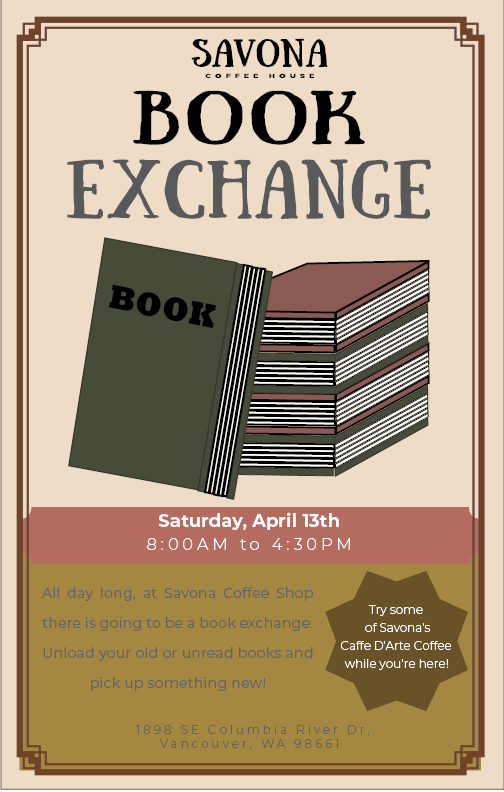
For the first poster, the biggest element is the graphic of the books. The second-largest element is the text “book exchange”. This effectively uses scale to draw the viewer’s attention. Color blocking is then used to draw the viewer’s attention to the event date and other information. The next-largest element is the text of the day and time for the book exchange. This is because what the event is and when it is are the most pertinent pieces of information.
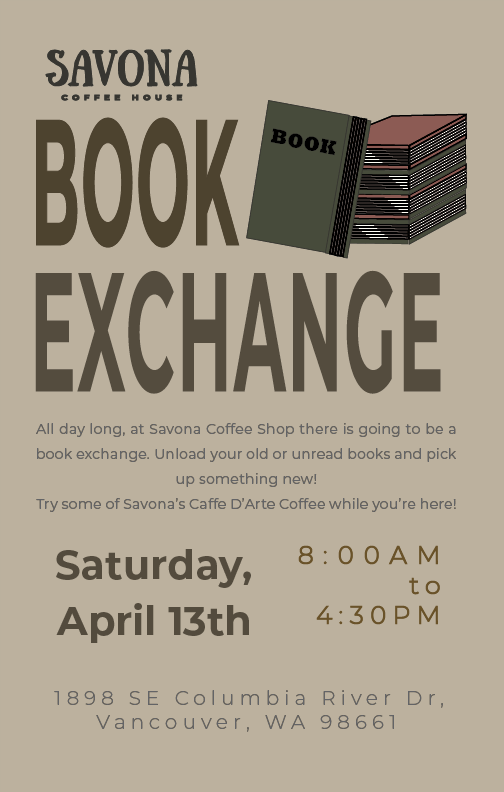
In the second poster, the largest elements are still the book graphic and the text “book exchange.” Though instead of the graphic being as large as the first one, it is scaled down to fit alongside the word “book” and before the word “exchange.” This is another way to show that these are the most important elements. The next size down in text is the date and time for the event. Then the address of the shop. This design places greater emphasis on the address than the last design did. While this is not the most important information, it is still important to know the address.
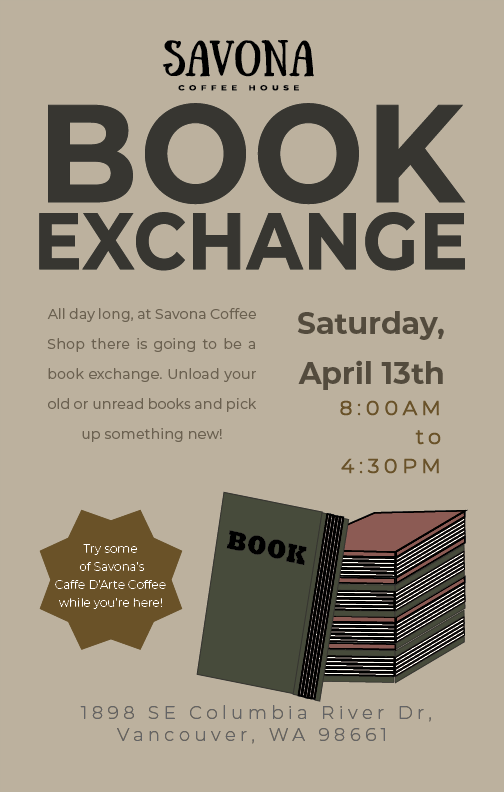
For the third poster, the same biggest elements remain with the words “book exchange” and the book graphic. This time, though, “Book Exchange” is much bigger than the graphic, and the graphic is at the bottom of the page. This draws more attention to the other text rather than the graphic, since the text “book exchange” already calls enough attention to itself with its scale. Like the last design, this one maintains the same text ranking and uses the same-colored star shape as in the first to emphasize the text, inviting the viewer to visit the Savona shop.
Conclusion
A useful way to organize information in design is to use hierarchy, deliberately varying the scale of elements, stylizing typography, and purposefully using color to prioritize and emphasize what is most important. The same information can be displayed in multiple ways by using hierarchy, as shown with the example of the book exchange posters. Thus, making it a very useful concept to consider within design.
Reference
Caldwell, C. (2019). Understanding Your Brand. In Graphic Design for Everyone: Understand the Building Blocks So You Can Do It Yourself (pg.127–155). essay, DK Publishing.
 Home
Home 